Featured

Switch Hitters – The journey so far

Started at the bottom…
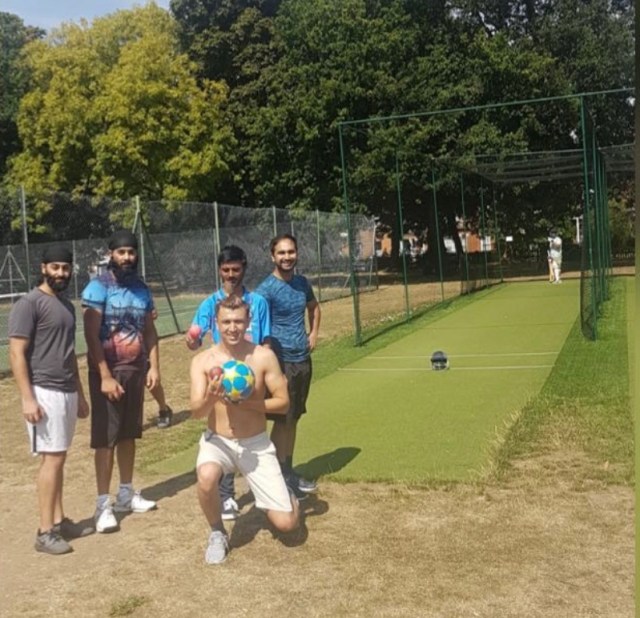
(the original gang with Sunny in the background as batsman)

A nomadic cricket club in Twickenham born out of friends, friends of friends and once strangers but now brothers.

2014: It all started simply out of boredom and general interest in the game of cricket, myself and few school friends (who I’ll be introducing shortly) decided to start playing cricket again. Previous experience was in school but at this point in time that was years and years ago so to say we were out of nick was an understatement.

Before moving on, it’s time for the introductions of the originals. Number one, enter Sabi. Probably the most experienced in the game in the beginning since he was coached by the legendary spin wizard Aussie, Shane Warne himself. And trained so well if I may say in the dark arts of leg spin that he can turn the ball irrespective of the surface. Yet despite all his talents with the ball, his batting was even better.

Next up? His twin brother (really?) Ashwinder aka Ash. The only way to tell them apart is when they played the game. Ash would be twice as fast when bowling and half as technically astute when batting. But don’t let that fool you; bowl in his preferred area and prepare to concede a boundary.

And finally the last member of the OG4, Rahil. The speedster from Lahore, although he’s hardly been there. When facing him even the best will struggle to lay bat on ball, simply because half the balls would be too quick and the rest…well lets just say they’ll be out of your reach. When batting he prefers to slap the ball through the off side, reminiscent of good old Indian soap operas.

So those were the first men who started the club without knowing what shape it would take in the years to come. The first couple of games were in the park with strangers and played soft balls. No pads, makeshift stumps and frequent variable bounce on irregular pitches which are better described as the flattest part of the park where there was the least amount of grass.

2015: These games slowly ignited the passion so old kits were dug out, indoor net sessions booked and techniques honed. This would continue for a while until the expense of £30 per hour started getting out of hand since one hour clearly wasn’t proving to be enough. So we searched for alternatives and found Marble Hill Park in Twickenham. The £5 per hour open nets were appealing with only the typical British weather raining on our parade, quite literally a lot of the time.

2016: More equipment was purchased; now the netting had become frequent and the skills refined. Enough cricket was being played that just nets weren’t enough to satisfy the cravings. I decided to join the local club, Spelthorne CC, soon after moving into the area.

2017: However due to the distance from the rest of the group, it was not feasible for them to attend the matches so I was the sole member to play actual matches. 40 over games practically every Sunday, home and away. I did it for a season and half but without any friends joining the club there really wasn’t enough motivation to keep playing.

2018: It was at this time that another member, Sunny, was introduced to the nets session group. After not playing for a decade, Sunny got into cricket very enthusiastically and as the rustiness started to wear off, he too wanted to dab into a game of actual cricket and so he joined the same club for a match. We played one game together, his debut match but that was about it. The season has practically over and by the time next season would start, Switch Hitters would have taken shape in it’s entirety.

2019: New year and new members. Another school friend Subhan was now back in the mix and keen to start cricket too. Ashwinder also introduced his cousin Dushant and Dushant introduced Gurmel. Sabi had brought in Kamal and by the time summer had arrived we had become members at Marble Hill Park and registered as Switch Hitters. A name derived on the spot and through sheer lack of creativity.

More and more people continued to join as the weeks passed by in the summer. Next batch of new comers included another old friend in Pritam joining us again (as he had played a solitary net session last year) and a brand new introduction, not just to the club but to the game of cricket itself, Abdullah, who I must say would surely get into the Palestine playing XI, should such a team exist.

May, 2019: With enough people, we mustered enough effort to book the cricket pitch one Sunday in the same park and tried to play a (gasps) real game of cricket, after years and years of nets only. The result of this was predictable. Since there are no consequences in nets; the batting had remained fragile from a survival perspective. See the thing is that in nets, all the batsmen bat their allocated time regardless of the number of dismissal and thus have not learnt the art of survival. This meant the game of cricket we played had several lives for each batsmen, no LBW dismissal and because we lacked an opposition nor did we have enough players to field two sides, the game was played in pairs with each pair batting out a certain number of overs and then fielding for the rest. The positive from all this? At least we had an outing on the pitch by this point.

July, 2019: And so we arrive at this point in time. Deciding yet again to book a pitch for another match few weeks later, the difference this time was the intention to play a full 11 v 11 game with the real rules of cricket. ICC would be proud and MCC rules rejoiced. The recruitment process was fervent and somehow 2 weeks before the game, we had gathered 22 players ready to play on the day.

As I write now the game has yet to take place but lets see how it goes. If all goes well, maybe we can start putting together a team on regular basis, challenge other local teams looking for a game and perhaps by next season, we can become an active nomadic team touring grounds in and around London.

Swing bowling

An art, a science or something else entirely?

Perhaps one of the most lethal deliveries in the game of cricket;  the swing ball can have the best of batsmen ducking, diving and, frankly, discombobulated as they’re left deceived by the trajectory they so confidently predicted when stepping in to face the ball.

At our Club, we swing both ways. But before we get into that, let’s review the theory.

Swing is the phenomena that occurs when a pace bowler channels the power of the Egyptian wind-god Shu to manipulate the trajectory of a ball in-flight. Some players will find it more useful to follow more modern chakra-bending structures extolled by Aang et al, that provide rigid movements to call forth the same levels of elemental meddling.

Okay so our understanding of the science is a bit sketchy, but there are some great explainers online including here and here (and if you really want to geek out, here).

Essentially, gripping the ball in a way that best uses the seam and the asymmetry of a ball (shiny-side v rough) will create swing. Bowlers will angle the seam away from the intended direction of travel so the shiny side of the ball faces the batsman. The ball will swing towards the direction that the seam is pointed – if the seam is angled toward the slip fielders it will swing away the batsman (outswinger) and if the seam is angled towards the leg side it will swing into the batsman (inswinger). Keeping the asymmetry of the ball is crucial to swing, which is why you’ll have seen a number of desperate (and often quite innovative) efforts to maintain shine over the years – minty saliva anyone? 

Once you’ve got the grip down, the next step is picking a spot. Of course, every good bowler will understand the importance of variation in an over, but one thing to really bear in mind when picking a spot as a swing bowler is that the more air-time the ball gets, the more time it has to deviate. As such, if you really want to impress your mates with a wide swinging ball, pitch it just short of yorker length. Unfortunately, your line will have to adjust with every delivery to account for the state of the ball and any changes in weather/pitch conditions.

We said earlier that we swing both ways at the Switch Hitters CC; our boys are here below to share some final words of wisdom for all you aspiring swingers

Dushant Waora – The King of Keeping it In

Ashwinder Bedi – Outie Without a Doubtie

Second innings…

So last year was a big deal for the club. We got two official matches under our belt, learnt a lot on how to run a club and since then have ramped about behind the scenes all the admin work to establish a platform we can use to start 2020 successfully.

A club logo is in place, the name “Switch Hitters” has stuck and there’s no going back now although come to think of it, no one has tattooed it anywhere just yet so maybe we can still change.

Email address? Check. Catch us on Twitter & Instagram? Yes. More equipment? Of course.

We’ve given ourselves the best chance to go out there and win some matches (still waiting on that first elusive win). Multiple friendly matches have been booked already and we’re still looking for more. More oppositions and players alike are welcomed so the search goes on…

Practice will kick into overdrive as soon as first signs of spring arrives and players are ready to take on more responsibilities and improve their own game for the team.

I wanted to finish the blog off with some profound statement about how the club is in a stage of metamorphism or a clever metaphor about us as a group of fledglings ready for flight or something cheesy like that but I think I’ll pass. Oh wait… time to pad up.

First match – interclub friendly

04.08.2019 – At long last we finally managed to play an actual match together. Between the core members of Switch Hitters and various friends of friends, we had 22 players on the field on a cloudy but mostly rain free Sunday.

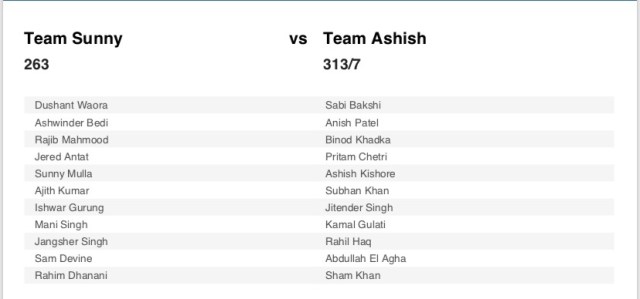
Toss – Sunny won the toss and decided to bowl first. An understandable decision as he had stacked his teams with the premium bowlers after also winning the second toss for the players draft. As a result, Ashish’s team ended up being batsmen heavy. Although in fairness both teams had plenty of bowling options and capable batsmen all the way down to the tail.

So the teams were as follows –

Spoiler alert!!!

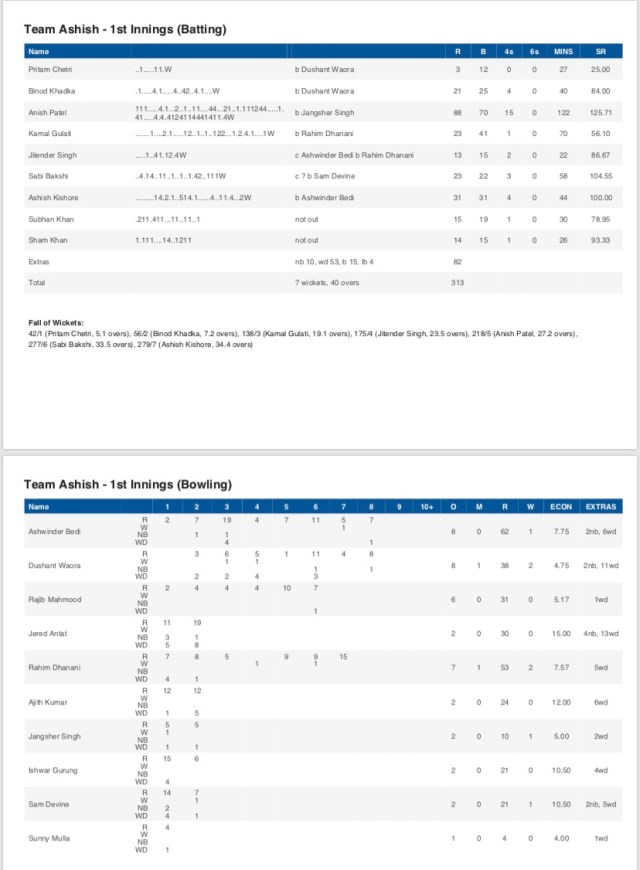
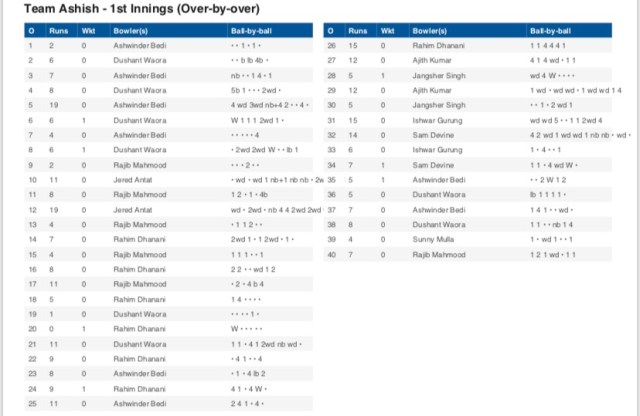
First innings – Put in to bat against the new ball and a formidable pace attack of Dushant, Ash, Rajib and Rahim, Team Ashish managed to post an above par 317/7 off the 40 overs with top scorer Anish (88) marginally outscoring Extras which contributed 82 (nb 10, wd 53, b 15, lb 4). No prizes for guessing what needs to be improved in the bowling department in the future, huh? Dushant and Rahim were the leading wicket takers with two scalps each.

Flat English pitch = high scoring game

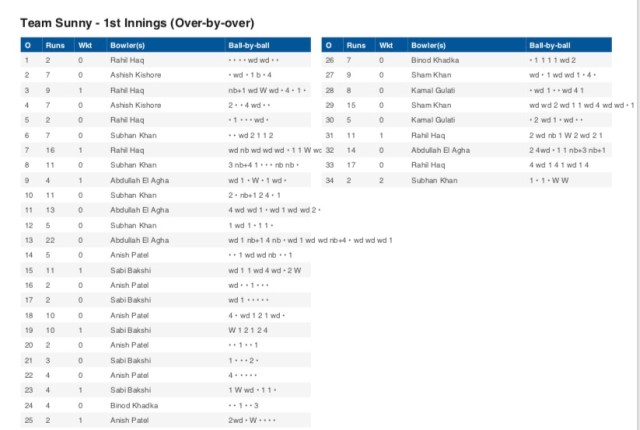
Second innings – Chasing a mammoth total, Team Sunny found themselves 12/1 in the 3rd over. Wickets then fell at regular interval with only Rajib (49) offering any significant resistance with some support, first from Ajith “Anna” and Sunny later down the order. Rahil and Sabi took three wickets each to derail the chase and Subhan finished off the innings with two wickets off consecutive balls to stay stranded on what could have been a potential hat-trick.

Chase was on but never looked comfortable…

And so the first match concluded, very late in the evening as the light faded, with some tired legs and broken bodies. We’ll need to get in better shape to keep the energy throughout the match, improve on the fielding, work on toning down the banter and focusing on bowling good line and length with consistency. Also a trip to Specsavers wouldn’t go amiss hehe..

Few moments on camera that were captured will be available in the Pictures and Video section so be sure to check them out. Until next time…

Ball by ball coverage below for the stats nerds

Some of these overs sure do go on and on…
Can you spot the overs without any wides?

A guide to formulate your batting order

But first a question – Why are cricketers hesitant to open?

This scenario usually presents itself at most amateur clubs at some point or another. Usually the waiting list for the opening slot is noticeably shorter than the highly-coveted middle order. The answer is fairly simple once you think about it from a batters perspective. You’ll have to face the fastest or most consistent bowlers, at their freshest and against a new ball that will be doing a bit assuming the infamous English overcast conditions decide to grace your match with their presence, which believe me they will.

In order for you to make any runs as opening, you’ll have to see off the threat of the new ball, take the shine off, tire the bowlers out and only then think about cashing-in. At that point if you get out, you’ll obviously miss out but at least you’ll have set your teammates in good stead to capitalise.

And this basically answers the second conundrum of deciding a batting order. Why oh why does everyone want to bat in the middle order?

As explained above, it’s because the ball isn’t new, there isn’t much movement, the opening (best) bowlers are off and there is less time to build an innings so there is the license to hit out from first ball with little consequence for failure.

Batting order – guide and expectations:

·       Top order (openers and batter three)

Openers – Require solid defence and the ability to play long. One batsman could be defensive minded who rotates strike and takes a while before playing shots and the other could be an attacking batsman.

Number 3 – Traditionally the best batsman in the team. Could come in at 0/1 and has to rebuild or after 80/1 and solidify the advantage. Should be good in defence and attack.

·       Upper Middle order (batters four to six)

Number 4 – Attacking batsman. Hopefully comes in after a good start against relatively weaker bowlers and dominates. Should be able to play spin well and rotate strike.

Number 5 & 6 – Licence to attack but still have enough time to settle in and build and innings.

·       Lower Middle order (batters seven and eight)

Number 7 & 8 – Most likely all-rounders who can bat as well as those above but come down the order due to bowling responsibility. When they come in, either you’re dominating and they’re there to drum up the total or you’re struggling and it’s their job to post a decent total on the board or finish the chase.

·       Tail Enders (batters nine to eleven)

Number 9, 10 & 11 – The main bowlers should be here. Batting ability may vary from really good to only adequate. Despite that they can be crucial as in a tight game it’ll be down to them to either hit the winning runs or add whatever extra runs they can add to the total.

At this juncture at our club, if games are played till 40th over, it’s likely everyone will have batted as the top & middle order has yet to master defence and the ability to play long innings.

Source – https://www.pitchvision.com/why-everyone-wants-to-bat-in-the-middle-order-and-what-to-do-about-it#/

Further Reading –

https://www.jstor.org/stable/40608270?seq=1#metadata_info_tab_contents

https://www.ncbi.nlm.nih.gov/pmc/articles/PMC3861747/

Design a site like this with WordPress.com
Get started